Everything I Know About Butter: The Quiet Power of Grass, Fat, Culture & Salt
In praise of the world’s simplest luxury.
✍🏻 Written by: Michelle Webb
I, too, was once an underinformed butter consumer.
A few years ago, we were in Charleston at The Obstinate Daughter. My son was two then — an expert in carbo-loading, like most toddlers. We ordered him noodles with butter alongside our much more ambitious dishes, and I swear it was the best thing on the table.
We asked the waitress what kind of butter they used. All she said was, “It’s from France.”
Interesting.
Around that same time, we were just getting The Cheese Shop off the ground but hadn’t ventured into butter yet. So I started digging: Isigny. Bordier. Animal Farm. Ploughgate Creamery. Butter in baskets and gold foil. Butter from New Zealand, Australia, Denmark. Amish butter rolled into graceful cylinders and wrapped in parchment.
No sticks. Salted. Golden yellow. Cultured. How different could it really be?
The Case for Ruin
Now, whenever I bring a plate of French butter to a table at Wedgewood, I always give a little warning before I set it down: this one’s going to ruin you.
It’s the butter equivalent of a heartbreaker — smooth, irresistible, and impossible to forget.
There’s a reason French butter ruins you for all the rest. It comes down to four things: the grass beneath the cows, the cultures that breathe life into the cream, the salt from the sea, and the fat that carries it all home.
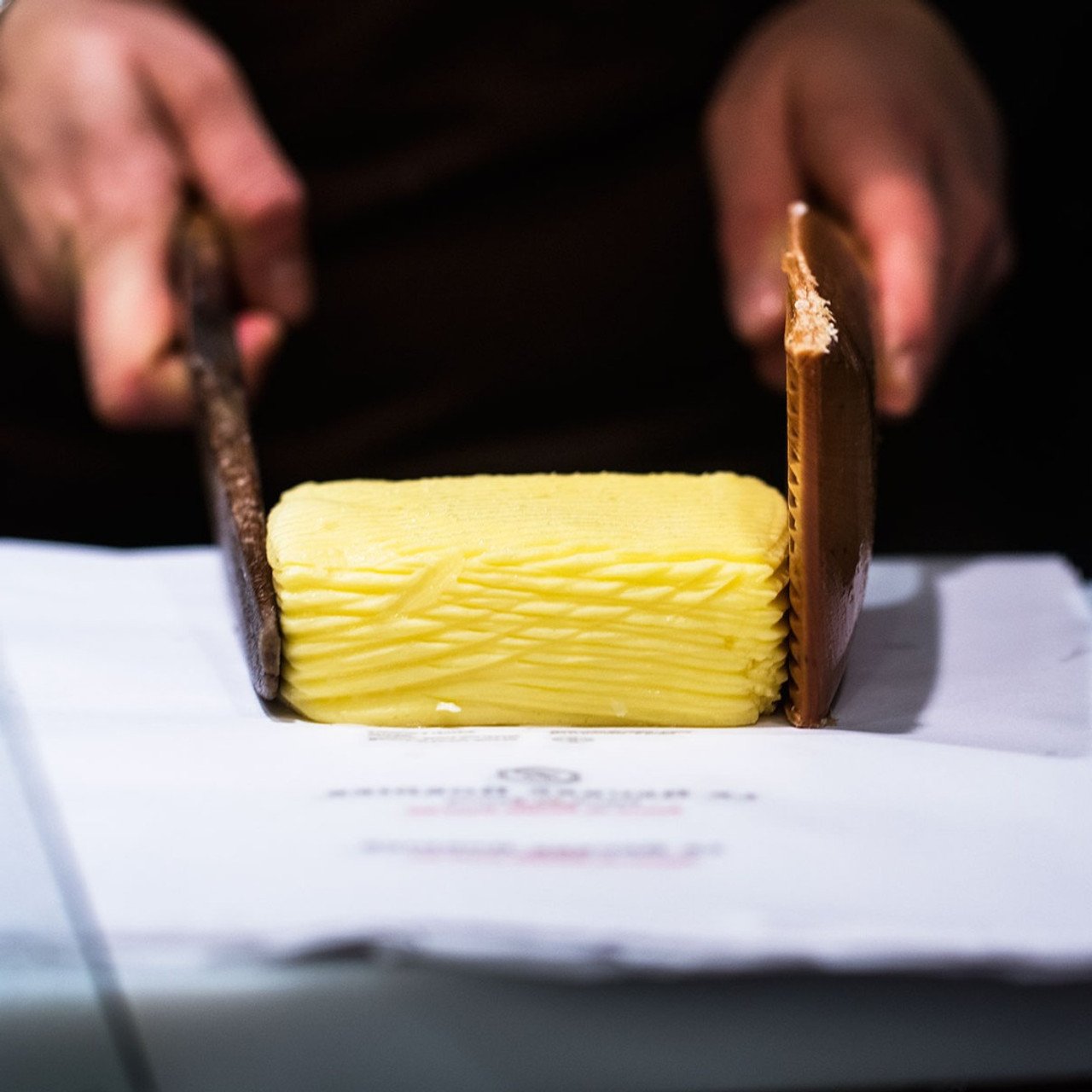
centuries-old technique; butter shaped by hand with wooden paddles at Maison Bordier in Brittany, France.
A Brief History of Cultured Butter
The story of butter is really the story of culture, commerce, and place. For centuries, it’s been both a food and a form of exchange — a way to preserve wealth, flavor, and time itself.
In Ireland, butter was once a kind of currency, salted heavily to survive long winters and sea voyages. Barrels of golden butter left Cork and Limerick for the ports of Europe, prized for the rich grass-fed cream that gave it color and depth. Those same coastal pastures — and the damp, salt-kissed air — still define Irish butter today.
In France, particularly in Brittany and Normandy, butter became identity. Local co-ops and small dairies turned cream into culture by fermenting it before churning, coaxing out that deep lactic tang that defines French pastry and cuisine. Geography played a quiet but decisive role: Brittany’s exemption from France’s historic gabelle (salt tax) meant its butter could be salted freely, while inland butters remained unsalted. That one bureaucratic detail changed the trajectory of French cooking forever.
And in Amish America, butter stayed close to its agrarian roots — sweet cream, churned thick on small farms, wrapped in parchment and sold by weight. It’s less about luxury than livelihood, but the result is no less extraordinary: dense, rich, and pure.
In the U.S., cultured butter disappeared almost overnight with the arrival of the mechanical cream separator in the early 1900s. The new efficiency gave us volume and uniformity — but it also gave us sweet cream butter, washing away the wild cultures and regional character that once defined the craft.
Today, cultured butter is having a quiet comeback. Across Vermont, the midwest, upstate New York, and the Pacific Northwest, small creameries are returning to old-world methods: fermenting cream before churning, sourcing milk from grass-fed herds, and shaping butter by hand. They’re chasing what industrialization nearly erased — simply put: flavor. The result is butter that tastes once again of its origins: bright, tangy, alive.
The Four Pillars of Great Butter
Across these traditions, there are four pillars that define great butter: grass, cultures, salt, and butterfat. Together, they’re what separate the merely good from the unforgettable.
Grass gives butter its foundation — its flavor, color, and even texture. The diet of the cow determines the taste of the cream, and the taste of the cream determines everything that follows. Spring butter, from cows grazing on clover, rye, and wildflowers, glows deep gold and carries a sweetness that borders on honeyed. Winter butter, when the herd feeds on hay and silage, turns paler and more restrained — a quieter kind of richness. The color comes from beta-carotene, the same pigment that makes carrots orange. When cows eat fresh grass, that beta-carotene passes into their milk fat, giving the butter its golden hue. As I like to tell people, “yellow butter equals happy cows.”
Cultures introduce depth and aroma, turning fresh cream into something layered and alive. Before industrial refrigeration, fermenting cream wasn’t a technique — it was a necessity. Today, it’s an art form. The cultures — usually Lactococcus lactis and Leuconostoc species — convert lactose into lactic acid, producing that unmistakable tang and a bouquet of subtle aromatics: hazelnut, hay, caramel, brioche. In a well-made cultured butter, that tang isn’t sharp or sour — it’s round, mellow, and utterly craveable.
Salt is structure, not seasoning — a preservative, a flavor amplifier, and a regional signature. The French have been saying this for centuries, especially in Brittany, where sea salt from Guérande gives butter its mineral depth and gentle crunch. Irish butter leans saltier, a reflection of its trading roots and wetter climate. Salt draws out water, concentrates flavor, and softens acidity. It’s what makes butter taste not just rich, but complete.
Butterfat is the measure of richness — the single metric that separates commodity butter from the stuff worth slowing down for. American supermarket butter is required to contain at least 80% fat; most European or Amish butters hover near 84–86%. Those few extra points make an enormous difference: higher butterfat means less water, less splatter, more flavor, and that velvety, almost custard-like texture that coats the palate and lingers.
Butter with Range: An Introduction to the Wedgewood Five
Butter, like people, has a spectrum of personality — from quiet to showy, from delicate to demanding. The more you taste, the more you begin to recognize them: their moods, their behavior under heat, their subtle lifts to a dish. At Wedgewood, we keep a core five that capture the full spectrum of butter’s moods —from the workhorses to the show ponies.
Butter of Parma — The Minimalist
From Parma, Italy, this delicate, unsalted butter is made from the same cream used for Parmigiano-Reggiano. It’s churned by small creameries in Emilia-Romagna, where cows graze on the same grass that flavors the region’s world-famous cheese. Because it’s unsalted and uncultured, its flavor is sweet and clean. This is the butter for transformation: the one that listens, adapts, takes on what you give it. It’s what you reach for when you want control. It’s perfect for compound butters and subtle upgrades — like this crispy ham butter,
Isigny St. Mere Beurre de Barrate — The Romantic
From Isigny-sur-Mer, in northern France, this PDO-protected butter comes from a lush coastal plain where salt marshes meet sea air. The cows graze on grasses rich in beta-carotene, giving the butter its signature golden hue. Isigny Ste-Mère’s butter is cultured and lightly salted, its flavor landing somewhere between brioche, sea breeze, and caramel. By all accounts, it’s a gateway butter — we sell nearly as much of it as we do cheese.
This is the butter of silk sauces and velvet finishes — and most likely the butter on those toddler noodles that started this whole adventure. The one that binds, glosses, and smooths the edges of acid and salt.
Welsh or Irish Butter — The Workhorse
Across the British Isles, from County Kerry to the hills of Wales, butter is golden and almost cheesy — a direct result of cows grazing outdoors on mineral-rich pastures most of the year. Brands like Kerrygold have popularized it globally, but the real story lies in the grass itself: dense, wet, nutrient-rich, perfuming the cream with chlorophyll and sunshine.
And a quick note for the label-readers: the Kerrygold you find in American grocery stores isn’t technically cultured — it’s a sweet-cream butter. The real Kerrygold sold in Ireland, though, is cultured, with that gentle lactic tang and complex finish that makes everything taste a little more alive.
This is butter with presence — nutty, grassy, bold. It wants to be tasted as itself: spread thick on brown bread, melted over potatoes, folded into something humble but honest. It’s butter that doesn’t hide behind pastry — it is the meal.
Amish Butter — The Purist
From small dairy co-ops in Ohio and Pennsylvania, Amish butter is the purest expression of sweet cream. It’s unsalted or barely salted, hand-churned, and shaped into thick rolls rather than blocks. With its exceptionally high butterfat (we’re talking 85-90%), it’s dense, rich, and almost custard-like — designed for baking, frying, and comfort.
Amish butter melts slowly and evenly, the way real butter should. It’s generous and steady — the kind that behaves in the pan, holds its shape in dough, and gives pastries that perfect, golden edge. High in butterfat and low in fuss, it’s the baker’s secret weapon.
Bordier Butter — The Diva
From Maison Bordier in Brittany, France, this is the butter that proves high maintenance can be worth the trouble. Jean-Yves Bordier is one of the last artisan butter makers to still knead butter by hand, a process that distributes salt and expels moisture slowly, creating texture as supple as ganache.
To become a butter maker at Bordier takes three years of training. The dairy sources its cream from small Breton farms, all within a day’s travel, and salts it with Guérande sea salt — harvested just miles away from the cream’s origin. The butter rests in oak barrels before being worked on marble tables, folded again and again until it breathes.
This is the butter you save for the end — a punctuation mark, a revelation, a reminder that simplicity can be transcendent. At Wedgewood, we couldn’t resist taking it one step further — we turned it into gelato. Buttery, cold, and impossibly silky.
Bringing It Home
At Wedgewood, we think about butter the way we think about cheese: as a living thing that reflects patience, season, and care. The more you taste, the more you realize — butter is every bit as complex as cheese, just subtler in its expression. It will surprise you.
Knowing which butter to use, at what time, and in what dish — that’s your quiet power.